


Beyond the Tourist Trail: Is a Travel & Tourism Degree Still Worth It?
The 4 AM Coffee Question
It was 4 in the morning when my friend Priya texted me. She was sitting in her dorm room—not working on assignments, but scrolling through job postings. “Four years and ₹20+ lakhs invested,” she wrote, “and I’m seeing travel agencies hire people with 3-month certificates. What am I doing wrong?”
That message haunted me because I knew she wasn’t alone.
The travel and tourism industry has this weird, beautiful contradiction: it’s one of the most exciting careers you can imagine, yet the pathway to getting there feels increasingly confusing. Do you need that fancy degree? Or is a certification enough? And honestly, with the rise of online programs and specialized training, is traditional university education even the best investment anymore?
Let’s talk about this—really talk about it. Not with rose-tinted glasses, but with real numbers, real experiences, and real alternatives.
The Traditional Degree vs. The New Reality
A 4-year degree in travel and tourism typically covers everything from hospitality management, destination marketing, to hotel management. It gives you a foundation, and yes, it still carries weight with certain employers—especially in corporate hotel chains and destination marketing organizations.
Cost: On average, a 4-year degree in India ranges from ₹8-20+ lakhs (private or government).
Timeline: Four years. During which the travel industry has probably changed three times.
But here’s what’s shifted:
There are now hundreds of specialized certifications—destination specialist, tour operator, content marketing for travel, social media marketing for hospitality—taking 3 months to 1 year and costing ₹20,000 to ₹3 lakhs.
According to 2025 salary data, professionals in tourism earn an average of ₹16.6 lakhs annually, with top 10% earning ₹23.6+ lakhs.
Here’s the uncomfortable truth: salary data shows no significant premium for having a 4-year degree versus relevant certifications. What matters more is what you can actually do and who you know.
The Case For Traditional Education (It’s Not Worthless)
Degrees have real advantages:
Backup Plan: If travel isn’t forever, a degree keeps career-switching doors open.
Broader Network: Four years at university means connections—classmates, professors, alumni, industry professionals.
Structured Learning: Business fundamentals, customer service psychology, revenue management, industry standards—all in one place.
Employer Credibility: For roles in major hospitality chains and tourism boards, degrees may be preferred.
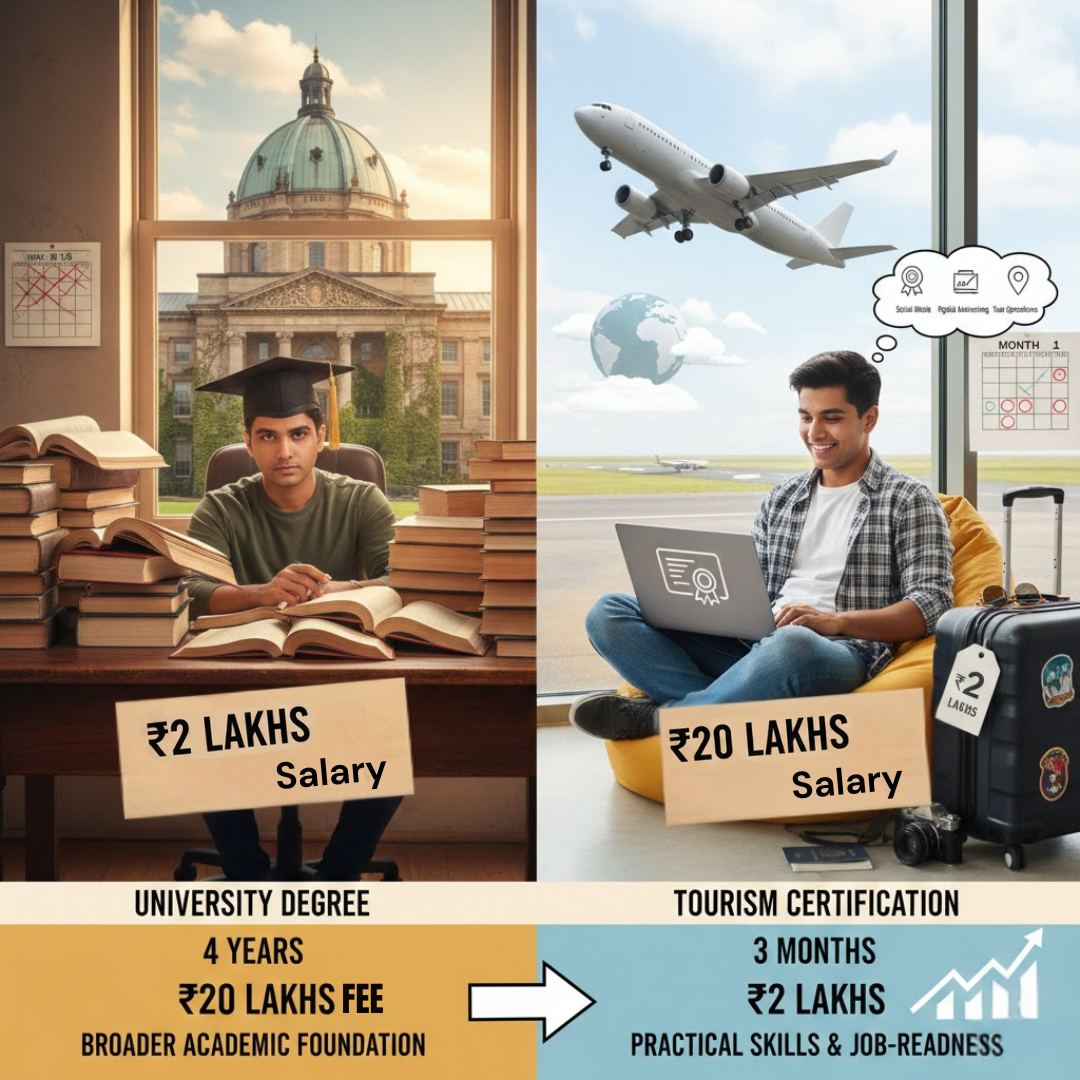
In 2025, practical skills and adaptability in the fast-changing travel industry matter far more to employers than traditional degrees. Certifications and real-world experience now open more doors than ever before.
The Case Against The Traditional Degree
Why so many like Priya are questioning the value:
- Time to Market: A 3-month certification could have you working years before a degree-holder.
- Industry Change: The travel sector changes every year—curriculum updates are slow.
- Practical Skills Gap: Certifications focus on what the industry needs right now—AI, content creation, digital marketing.
- Cost vs. Earning: Degree = ₹23-27 lakhs investment; Certification + working = breakeven in under 1 year.
- Job Placements: Online learning platforms report 60-70% placement rates in 3-6 months; universities average 40-50% in 6 months.
The Middle Ground (Where The Magic Happens)
Neither option is wrong—they serve different goals.
Choose the 4-year degree if:
- You want to work in corporate hospitality or tourism boards
- You prefer deep foundational study
- Your family values degrees
Choose certifications + working if:
- You’re career-ready and prefer hands-on learning
- You want quick employment and specialized skills
- You value practical over theoretical knowledge
Best answer? Combine them. Start with a certification to enter the workforce, then pursue further study or a degree for career growth later.
What the Industry Actually Wants
Interviewed tourism managers and recruiters say they look for:
- Relevant Experience
- Demonstrated Skills
- Industry Certifications
- University Degree (nice-to-have but not required)
- Personality and passion for travel
Notice where the degree falls? Position #4.
The travel industry is hungry; it’s expected to grow at a CAGR of 14.1% from 2025 to 2030. What counts? Your willingness to keep learning and delivering real results.
The Real Investment
So, the real question is: “How do I build a fulfilling travel career as efficiently and practically as possible?“
The answer varies, but in 2025, the combination of fast, skill-based learning and real-world experience is winning.
Did you get a degree, certification, or jump straight in? Share your story below!
Share:

ourwebtechinnovation@gmail.com
3 Comments
Neque porro quisquam est, qui is dolor emr ipsum quia dolor sit amet the consec tetur is adipisci velit, sed Neque porro.
Neque porro quisquam est, qui is dolor emr ipsum quia dolor sit amet the consec tetur is adipisci velit, sed Neque porro.
Neque porro quisquam est, qui is dolor emr ipsum quia dolor sit amet the consec tetur is adipisci velit, sed Neque porro.